|
Kapitza in Cambridge and Moscow
J W Boag, PE Rubinin and D Shoenberg
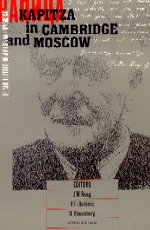 North Holland 1990
ISBN 0 444 98753 3 (hardbound), 0 444 98749 5 (paperback)
429 pages. Hard or soft cover.
80 black/white photos embedded in the text.
Purchasing Details.
Out of Print
My Comments on This Book.
Like all books about Peter Kapitza, Rutherford features so much and so strongly that the book makes this list.
Of all the young scientists attracted to work with Rutherford, only Kapitza and a radio scientist carved out their
own research fields. Kapitza was the most colourful and the one with international intrigue.
After one year of working with Rutherford, during which he confirmed that the alpha particle had no energy left at
the end of its range in air, Kapitza convinced Rutherford to fund the development of methods of producing pulsed, but
very high, magnetic fields. As these might be of use to Rutherford's work, who had been the first to use magnetic
fields to deviate alpha particles, Rutherford raised considerable sums in support of Kapitza, culminating in having
the Mond Laboratory built. By then Kapitza had expanded into low temperature physics. So when Kapitza returned to Russia
for his usual summer visit in 1934 it was a shock to all to learn that Russia was not allowing his return to Cambridge.
Kapitza was forced to advance science and technology in his homeland. Rutherford's fruitless, behind-the-scenes then
public negotiations were finally abandoned and his last support of Kapitza was to allow Russia to purchase much of Kapitza's
equipment at the Cavendish. In 1978 Kapitza was awarded a Nobel Prize in Physics for "his basic inventions and discoveries
in the area of low-temperature physics." His helium liquifier was commercialised by Collins and the Arthur D Little companies
and facilitated low temperature research world-wide.
P Rubinin was Kapitza's personal assistant and David Schoenberg was Kapitza's last student of low temperature
research at Cambridge. They are eminently placed to select and translate into English Kapitza's letters home and
abroad through to Kapitza's death in 1984. Rubinin's 84 page biographical article on Kapitza gives an account of his life and work.
Errors Noted.
None known.
back to top
Contents
| Chapter |
|
|
|
Preface |
v
|
|
List of illustrations |
xiii
|
|
Sources of illustration |
xvi
|
| 1 |
Biographical introduction
|
1
|
| 2 |
Some early letters (1913-1920)
|
87
|
| 3 |
Letters to his mother (1921-1927)
|
111
|
| 4 |
Letters from Moscow to Anna Kapitza in Cambridge (1934-1935)
|
209
|
| 5 |
Correspondence with Rutherford (1921-1937)
|
257
|
| 6 |
Letters to the Kremlin (1929-1980)
|
313
|
| 7 |
Index of Names
|
421
|
|
Index ofnames
|
421
|
|


