Bill Pickering - A Brief Biography
John Campbell
john.campbell -at- canterbury.ac.nz
(I first wrote a version of this for newspapers to mark the opening of the Pickering/Rutherford/Havelock Memorial.)
It is not well known in New Zealand,
or in America, that the man responsible for America's first satellite, and who led their unmanned deep space
research, came from New Zealand.
 Bill Pickering, the director of Cal Tech's Jet Propulsion Laboratory, in the Oval Office of the White House,
presenting a model of Mariner II, which explored Venus, to President Kennedy. 17th Jan 1963.
Bill Pickering, the director of Cal Tech's Jet Propulsion Laboratory, in the Oval Office of the White House,
presenting a model of Mariner II, which explored Venus, to President Kennedy. 17th Jan 1963.
Childhood
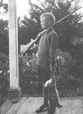
Havelock in the Marlborough Sounds is unique. Two New Zealand icons of science and technology,
Ernest Rutherford and William Pickering, attended school there.
Bill Pickering was born in Wellington on Christmas eve, 1910. Tragically, his mother died when Bill
was four. He was sent to Havelock to be raised by his paternal grandparents, William and Kate Pickering.
William Pickering had pioneered coach routes in Marlborough, being the first to drive a coach from
Blenheim to Nelson.
Bill's life was much the same as Ern's had been three decades earlier. Feeding the family chickens,
hunting for their eggs, fetching and cutting firewood for the family stove and fireplaces, fishing
off the wharf for herring, and catching eels at Kaituna River. Their school lives were also similar
and both sung at school or church concerts.
Bill's life interest in electricity was initially stimulated when Havelock's first electric power
scheme opened. It was a modest one driven by the creek that supplied the town's water supply and ran
for just two hours each evening. But it was enough to inspire a boy.
In 1923 Bill went to Wellington College. Radio broadcasting was just starting. Bill's attention
turned to this modern application of electricity. He built a crystal radio set. On holiday he
introduced this new technology to Havelock. His grandmother was horrified to listen in to the type
of popular music broadcast on a Sunday by a Sydney radio. However, she endeavoured to encourage his
new-found interest. On learning that a crystal (actually a semiconductor) was the heart of this
new magic, she gave Bill one of her best crystal glasses (a non-conductor) thinking he could use that.
In 1924 Bill (aged 13) and Fred White and others founded the Wellington College Radio Club and built
a radio transmitter with which they communicated, via morse code, with other enthusiasts as far away
as the USA. Wellington College was the first school in New Zealand to hold an amateur radio license.
Bill can still tap out its call sign Z2BL in Morse code.
Fred White
After graduating from Victoria University College of Wellington, Fred White in 1929 went to Britain's
Cavendish Laboratory, where Rutherford was director, to work on radio under Jack Ratcliffe. In 1937
he returned to New Zealand, to the chair in physics at Canterbury College and with radio research
funds Rutherford extracted from the New Zealand Government. During the war Fred went to Australia
on radar research, where he stayed and eventually rose to a knighthood and Director of the Commonwealth
Scientific and Industrial Research Organisation - CSIRO.
back to top
University Education

In 1928 Bill did the engineering intermediate course at Canterbury College when fate once again
intervened. An uncle married an American woman and they took him to America. He obtained three degrees
from the California Institute of Technology (Cal Tech), in physics and electrical engineering. Bill
carried out research on the nature and origin of cosmic rays with Robert Millikan, who had received
a Nobel Prize for accurately measuring the electrical charge on the electron. Bill used a Geiger-Muller
tube and measured its dead-time. (By a quirk of fate, this device started as the Rutherford-Geiger detector,
the first electrical method of detecting individual charged particles omitted during radioactive decay.)
In 1933 he also built two Geiger tubes and the associated control electronics to automatically trigger
a cloud chamber photograph when a cosmic ray shower triggered both detectors, one above and one below the
chamber. The shower was generated in a lead block above the first detector and the cloud chamber was in a large
magnetic field so the charge and energy of the particles produced could be determined. This work was
published in Anderson, Millikan, Neddermeyer and Pickering, Physical Review, 45 352-363 1934.
Carl Anderson received the Nobel Prize for his proof, using such equipment, that positive electrons existed.
Bill's main interest switched to transmitting data from balloon-born equipment, then later from early
rocketry flights. Cal Tech was a prewar pioneer in rocketry.
The photo shows Bill (in the telemetry van) with Robert Millikan in Mexico c1942 carrying out
balloon-borne cosmic ray experiments.
back to top
Reaching for Space

Bill was on the staff at Cal Tech
from 1936, and, in 1944, also joined its Jet Propulsion Laboratory (JPL). In 1947 his frequency modulation
telemetry system for transmitting data from rockets was adopted as the standard. In 1947 Bill headed
the JPL team which converted the Corporal research rocket into the USA's first surface-to-surface guided
ballistic missile. He was elevated to Director of JPL in 1954.
The USA administration was not interested in putting a satellite in orbit as such effort would take
resources from the military rocket programme. That attitude changed overnight when, on October 4th 1957,
Russia launched Sputnik 1. The space race was on. Not suprisingly, Bill chose a comsic ray experiment
for his first payload. The principal researcher was James Van Allen who was tracked down to being on
an ice-breaker in the Antarctic and rushed home through Christchurch to begin work assembling the equipment.
The heart was a GM tube, continuing the link back to Ernest Rutherford. Within four months of Sputnik,
Bill was ready to launch. He had worked for the Army on medium range rockets (200 or so kilometres). The Navy
had been responsible for long range rockets so, in front of a large media contingent, the Navy launched
first. Their vanguard rocket blew up on the launch-pad, to considerable national embarrassment.
JPL launched in secret on January 31st 1958. Astutely, Bill, in Washington, was going to wait until
Explorer 1 had completed one orbit before making any announcement. When the time came for the satellite
to emerge from behind the Earth there was only silence. A few agonising minutes later, the radio signals
were picked up. The satellite had gone into a slightly different orbit so took longer rounding the Earth.
For Bill it was the longest wait of his life. The midnight Press conference brought in an excited and
large crowd of media people. By morning Bill was famous throughout America, even though the Army
claimed all the credit.

The USA's space programme was quickly condensed into a new, non-military agency The National Aeronautical
and Space Agency (NASA). Bill was offered a choice for JPL's role: Earth satellites, the manned space
programme, or unmanned deep space research. He chose the latter, a role JPL fulfills well to this day.
For some years the USA played catchup with Russia's space programme. It wasn't until 1963 that the USA
finally beat Russia at something. JPL's Mariner spacecraft to Venus propelled Bill onto the first of
his two covers of Time magazine.
Many other missions followed, including close-up photography of the moon to choose landing sites for
the manned programme. Bill regards the Ranger VII spacecraft of 1964 as one of his major achievements.
As indicated by the number there were prior failures. Before impact, Ranger IV returned the first close-up
photographs of the Moon's surface, paving the way for Neil Armstrong's first steps on the Moon on
the 20th of July 1969.
back to top
Honours

Bill's many honours include a National Medal of Science (the USA's highest scientific honour),
an honorary knighthood from the Queen, and an Order of Merit from New Zealand.
With the substantial monetary prize which accompanied the 1993 award of the Francois-Xavier Bagnoud
Aerospace Award, Bill established a scholarship to allow excellent New Zealand students to do research
at Cal Tech.
It is fitting that in a small village in New Zealand there is on the landscape a permanent monument,
honouring two New Zealand country boys who rose to international fame through their interest in science
and technology:- a place where New Zealanders can come to learn about, and appreciate, a space pioneer, and
where Americans can learn of the New Zealand connection.
The photo shows Bill giving a public lecture at the Christchurch Town Hall after receiving an honorary
PhD in Engineering from the University of Canterbury, 18th March 2003. Bill died at his home, of
pneumonia following a respiratory infection, on March 16th 2004 age 93.
Other Short Biographies
New Zealand Edge (www.nzedge.com)
has a heroes section which includes several New Zealand scientists, including Pickering. I do not know
who wrote this article.
back to top
|


